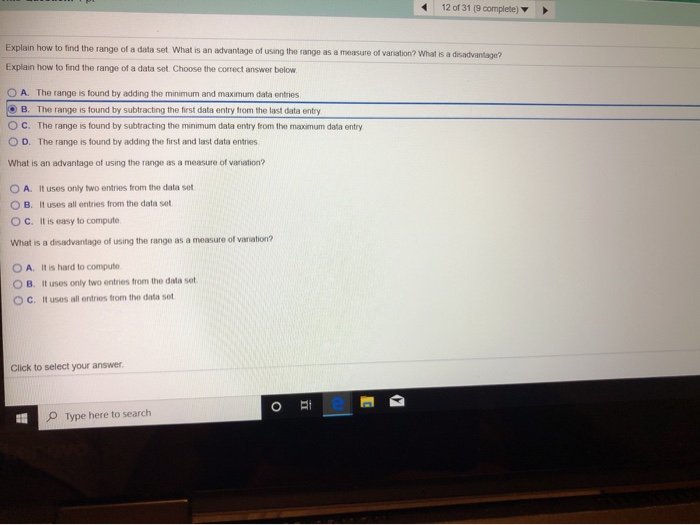
A disadvantage of using the range as a measure of variation is its sole focus on the minimum and maximum values, neglecting the distribution in between. This limitation can lead to oversimplification and potentially misleading conclusions about the spread of data. By relying solely on the range, important details about the variability within the dataset may be overlooked, affecting the overall accuracy of the analysis. Understanding why this drawback exists is essential for making informed decisions when choosing a suitable measure of variation.

What is a Disadvantage of Using the Range as a Measure of Variation?
Welcome young learners, today we are going to dive into the world of math to uncover a fascinating topic – the range as a measure of variation. While the range can be a helpful tool in understanding data, it also comes with its own set of limitations. Let’s explore together what disadvantages are associated with using the range as a measure of variation.
Understanding the Range
Before we delve into the disadvantages, let’s quickly revisit what the range actually means. In math, the range is defined as the difference between the highest and lowest values in a dataset. It gives us a simple way to see the spread or variability of our data points. For example, if we have a list of numbers like 3, 5, 8, 10, and 12, the range would be 12 (the highest value) minus 3 (the lowest value), which equals 9.
The Limitation of Outliers
One of the biggest disadvantages of relying solely on the range is its sensitivity to outliers. An outlier is a data point that significantly differs from the rest of the dataset. Let’s say we have a set of numbers: 4, 6, 8, 10, and 100. The range in this case would be 100 (the outlier) minus 4 (the lowest non-outlier), giving us a range of 96. As you can see, the presence of an outlier can skew the range significantly, making it less representative of the overall spread of the data.
Incomplete Picture of Variability
Another limitation of the range is that it provides an incomplete picture of variability. While it tells us how far apart the highest and lowest values are, it doesn’t give us any information about the distribution of the values in between. For instance, two datasets with the same range could have very different patterns of distribution within that range. This means that the range alone may not capture the true essence of how the data is spread out.
Impact of Sample Size
Sample size also plays a crucial role in the effectiveness of the range as a measure of variation. In smaller datasets, the range tends to be more influenced by extreme values, leading to a potentially distorted view of the data’s spread. On the other hand, in larger datasets, the range may not accurately reflect the true variability as it is heavily dependent on just two values – the maximum and minimum. This dependency on a small fraction of the data points can limit the range’s reliability.
Alternative Measures of Variation
Given the limitations of the range, it’s essential to explore alternative measures of variation that can provide a more comprehensive understanding of the data. One such measure is the standard deviation, which takes into account every data point in the dataset rather than just the extremes. Standard deviation offers a more robust way to quantify variability and is less influenced by outliers compared to the range.
As we wrap up our exploration of the disadvantages of using the range as a measure of variation, it’s important to remember that while the range can give us a quick glimpse into the spread of data, it may not always paint a complete picture. By being aware of its limitations and considering alternative measures of variation, we can better analyze and interpret data to make informed decisions. Keep exploring the fascinating world of math, young learners, and remember to always question, learn, and grow!
That’s all for now, until next time!
What is a disadvantage of using the range as a measure of variation?
Frequently Asked Questions
What are the limitations of using range as a measure of variation?
While the range provides a simple and quick way to understand the spread of data, it has limitations. One major disadvantage is that the range only considers the two extreme values in the dataset, neglecting the rest of the data points. This can lead to an inaccurate representation of the overall variability within the data.
How does the range fail to provide a complete picture of variability?
The range does not take into account the distribution of values between the minimum and maximum points, ignoring the potential outliers and differences within the data set. Consequently, it may not accurately capture the dispersion or consistency of the data points, limiting its usefulness in certain analyses.
What issues can arise when relying solely on the range for measuring variation?
Relying solely on the range can result in overlooking the central tendency of the data and the shape of the distribution. This can be problematic, especially when dealing with skewed data or when trying to compare variability across different datasets, as the range alone does not provide a comprehensive assessment of the variation present.
Final Thoughts
Using the range as a measure of variation provides a quick snapshot of the spread in a dataset. However, its major disadvantage lies in its sensitivity to outliers. Outliers can heavily skew the range, giving a misleading representation of the data’s dispersion. In conclusion, what is a disadvantage of using the range as a measure of variation? It fails to account for the overall distribution and can be greatly influenced by extreme values.